


We Let Our AI Answer 50 Hard Questions About Our Business

Steven Palange
CAO CIO CSO & CISSP | Thought Leader | AI Integration & Governance Advisor to CIOs, CISOs, and CFOs Specialist in AI ROI, Risk, Compliance, and AI-Ready
Written by Steven Palange, CAO, CIO, CSO, & CISSP | Thought Leader | Helping CXOs & IT Leaders Solve Automation, AI, Cybersecurity, and Cloud with Proven, Scalable Solutions. E:steven_palange@tlic.com P: 401-214-5557
Most phone systems can route calls. Ours Can Reason.
So we tested it.
We asked our AI Phone Agent 50 real-world questions — the kind actual business owners, IT directors, and security leaders would ask.
Here’s what happened.
Special Section
Want to See All 50?
We documented every single question we used to stress-test our AI Voice Agent. All 50. From basic service questions… to cybersecurity depth… to AI governance… to real-world interruption scenarios. It’s not a brochure. It’s a live-fire evaluation framework. If you want to see the full list — and use it to test your own systems — Download the complete AI Phone Agent Stress Test (50 Questions) down below:
Try them.
Interrupt mid-sentence. Change topics. Simulate a real buyer.
If your current phone system can survive that… you’re ahead of most businesses.
Special Section:
Infographics, Video, & Audio Learning Guide that summarizes this Newsletter Article for Busy Professionals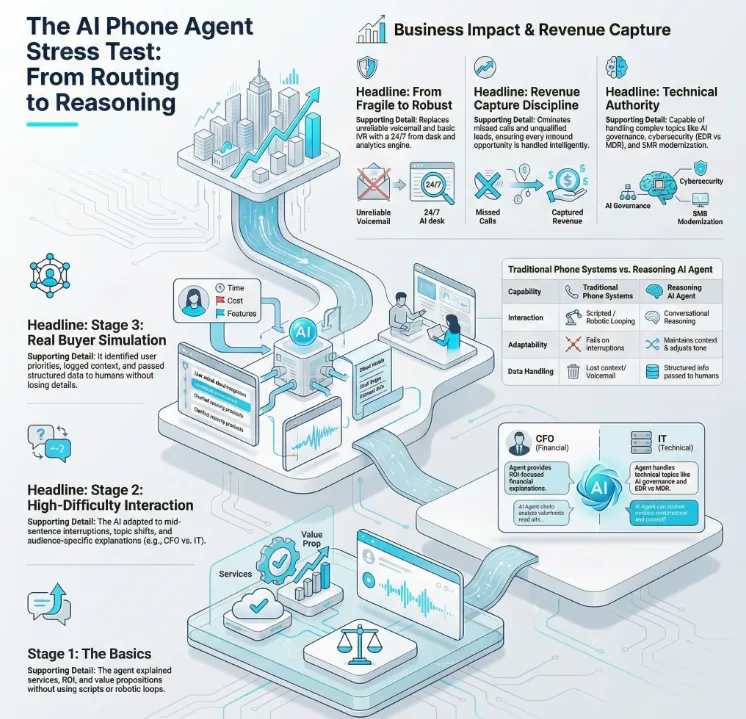
🔊Listen to the Strategy Podcast
🎥Watch the Executive Briefing (Video)
-
Don’t Just Read About It. Call It.
You can call our AI Phone Agent yourself. Interrupt it. Change topics mid-sentence. Ask technical questions. Demand escalation. See how it responds. -
Call: 401 227 3451
If it can’t handle your questions, you’ll know. If it can… that’s a different conversation.
First, The Basics
We started simple: “What services does Soveraign provide?” “How are you different from an IVR?” “What’s the ROI of replacing voicemail with AI?” The agent didn’t just route. It explained: • Services clearly • Value proposition concisely • ROI in business terms • And escalated when needed No script reading. No robotic looping.Then We Increased the Difficulty
We interrupted it mid-sentence. Changed topics halfway through. Spoke quickly. Asked it to compare EDR vs MDR in 60 seconds. Asked it to explain Shadow AI risk to a CFO. It adapted. Maintained context. Adjusted explanations by audience. Escalated intelligently when required. That’s not a phone tree. That’s conversational reasoning.Then, We Simulated Real Buyers
- “I’m an IT Director with 400 users. What should I modernize first?”
- “I’m a 75-user SMB. Where do I start with AI?”
Why This Matters
Every inbound call is: • A revenue opportunity • A security discussion • A sales lead • Or a support request Most SMBs still rely on: • Voicemail • Basic IVR • Or whoever happens to answer That’s fragile. An AI Voice Agent becomes: • 24/7 front desk • First-level sales qualifier • Technical explainer • Escalation router • Analytics engine All without adding payroll.The Bigger Question
If your business received 30–100 inbound calls per week:
• How many are missed?
• How many go to voicemail?
• How many aren’t qualified properly?
• How much context is lost before a human joins?
Now multiply that by job value.
This isn’t about AI novelty. It’s about revenue capture discipline.
If you’re curious what your AI front desk could handle, we’re offering a live demo where you can ask it anything — interrupt it, test it, challenge it.
We encourage it.
Because if it can handle 50 hard questions about cybersecurity, AI governance, and SMB modernization…
It can handle your customers.
Missed Last Week’s Issue?
If you haven’t read our previous newsletter on revenue leakage and missed calls, start there.
It explains why:
Every missed call is lost revenue.
And why most businesses don’t measure it.
This issue builds on that foundation.
Hey where does this message go?