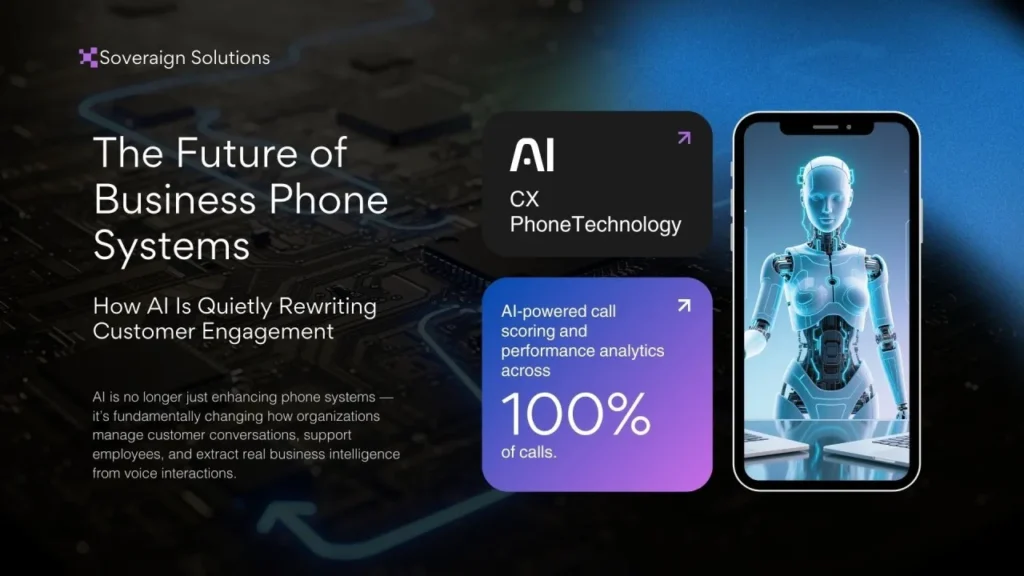
The Future of Business Phone Systems: How AI Is Quietly Rewriting Customer Engagement

Steven Palange
CAO CIO CSO & CISSP | Thought Leader | AI Integration & Governance Advisor to CIOs, CISOs, and CFOs Specialist in AI ROI, Risk, Compliance, and AI-Ready
Special Section: Infographics, Video, & Audio Learning Guide
🔊Listen to the Strategy Podcast
An in-depth discussion of this newsletter (Click to Listen)
🎥Watch the Executive Briefing (Video)
A 2-minute overview of this newsletter ( Click to watch )
Most executives still think of AI in business phone systems as simple automation.
The data tells a very different story.
AI is no longer just enhancing phone systems — it’s fundamentally changing how organizations manage customer conversations, support employees, and extract real business intelligence from voice interactions.
Recent industry research shows that:
- Over half of organizations have already integrated AI into phone-based customer conversations
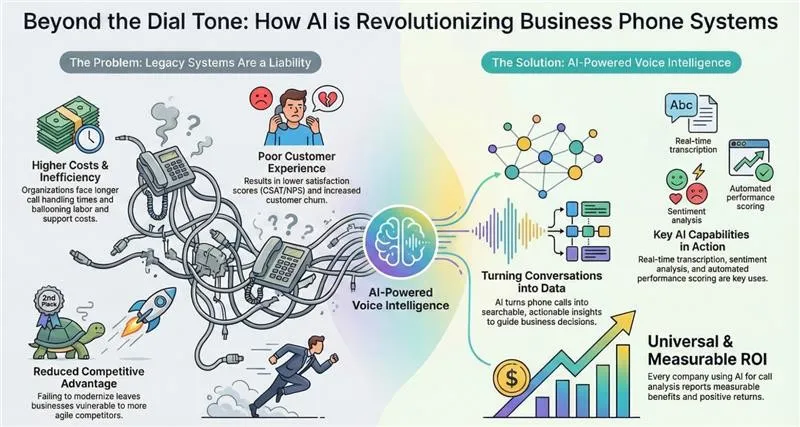
- Every company using AI to analyze call reports has measurable benefits
That combination — rapid adoption and universal ROI — is rare in enterprise technology.
What Leaders Are Actually Using AI Phone Systems For
The most valuable AI capabilities in modern phone systems aren’t flashy. They’re practical, operational, and measurable.
Leading organizations are using AI for:
- Real-time call transcription and automated summaries
- AI-powered call scoring and performance analytics across 100% of calls
- Sentiment and intent detection during live conversations
- Intelligent virtual agents handling routine inbound calls
- Real-time AI assistance for employees during live customer interactions
The impact is immediate: shorter wait times, faster resolution, more consistent service — and critically, reduced employee burnout from repetitive or high-pressure calls.
The Real Breakthrough: Voice Intelligence, Not Just Telephony
The real shift isn’t replacing phone systems.
It’s turning them into intelligence platforms.
Instead of guessing:
- Why calls escalate
- Where training gaps exist
- Which scripts convert
- Why customers churn
AI-enabled phone systems provide objective, searchable, and actionable insight across every conversation.
Organizations using AI-driven voice analytics consistently report:
- Faster issue resolution
- Higher customer satisfaction
- Fewer complaints
- Better upsell and cross-sell timing
- Stronger operational consistency
Phone calls are no longer just conversations — they’re data.
The Cost of Standing Still
The research is detailed: delaying AI adoption in phone systems has real consequences.
Leaders expect organizations that don’t modernize to face:
- Longer call handling times
- Higher labor and support costs
- Lower CSAT and NPS scores
- Increased customer churn
- Reduced competitive advantage
At a time when customers already view long hold times as unacceptable, legacy phone systems are quickly becoming a liability.
How to Modernize Phone Systems Without Disruption
Organizations that succeed don’t rush — they execute with discipline.
The most effective approaches:
- Tie AI phone initiatives directly to business KPIs (CSAT, AHT, resolution speed)
- Select AI capabilities based on specific call-related pain points
- Prepare teams early and address change management head-on
- Measure outcomes continuously and refine fast
AI adoption works best when it’s practical, targeted, and measurable.
Bottom Line
Business phone systems are no longer just communication tools.
They are becoming core intelligence infrastructure.
The winners won’t be the companies that simply “add AI,” but those that turn every phone call into insight, efficiency, and competitive advantage.
✅ Cybersecurity trends
✅ AI transformation
✅ IT strategy for Banking, Financial Services, and Healthcare