

AI Takes a Village — and a Tech Stack (and Someone to Run It)

AI Takes a Village — and a Tech Stack (and Someone to Run It)

Steven Palange

CAO CIO CSO & CISSP | Thought Leader | AI Integration & Governance Advisor to CIOs, CISOs, and CFOs Specialist in AI ROI, Risk, Compliance, and AI-Ready


Written by Steven Palange, CAO, CIO, CSO, & CISSP | Thought Leader | Helping CXOs & IT Leaders Solve Automation, AI, Cybersecurity, and Cloud with Proven, Scalable Solutions. E:steven_palange@tlic.com P: 401-214-5557
Special Section: Infographics, Video, & Audio Learning Guide that summarizes this Newsletter Article for Busy Professionals
🔊Listen to the Strategy Podcast
🎥Watch the Executive Briefing (Video)

Most organizations are not behind on AI anymore.

They’re overloaded.

Copilot is deployed. ChatGPT is approved. SaaS platforms quietly added AI features. Power users are experimenting beyond policy.

On paper, adoption looks healthy.

In reality, the pattern looks different:

  • Productivity gains are inconsistent
  • Risk is rising quietly
  • Costs are creeping upward
  • Accountability is unclear

And leadership keeps asking the same question:

“What AI are we actually running — and who owns it?”

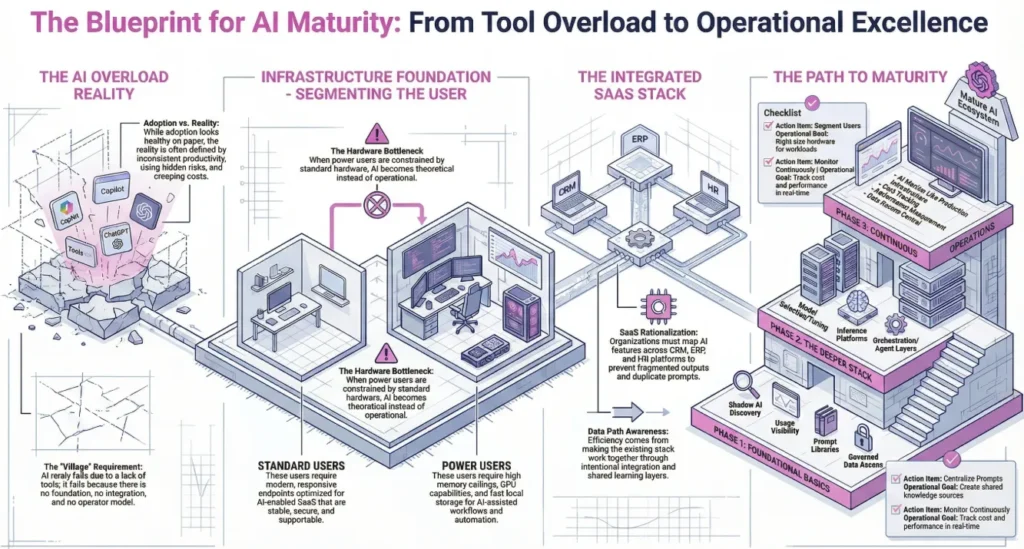
AI rarely fails because of missing tools. It fails because there is no foundation, no integration, and no operator model.

AI takes a village — and a stack — and people who can run both.

The Layer Most Companies Underestimate: Hardware

AI exposes weak infrastructure immediately.

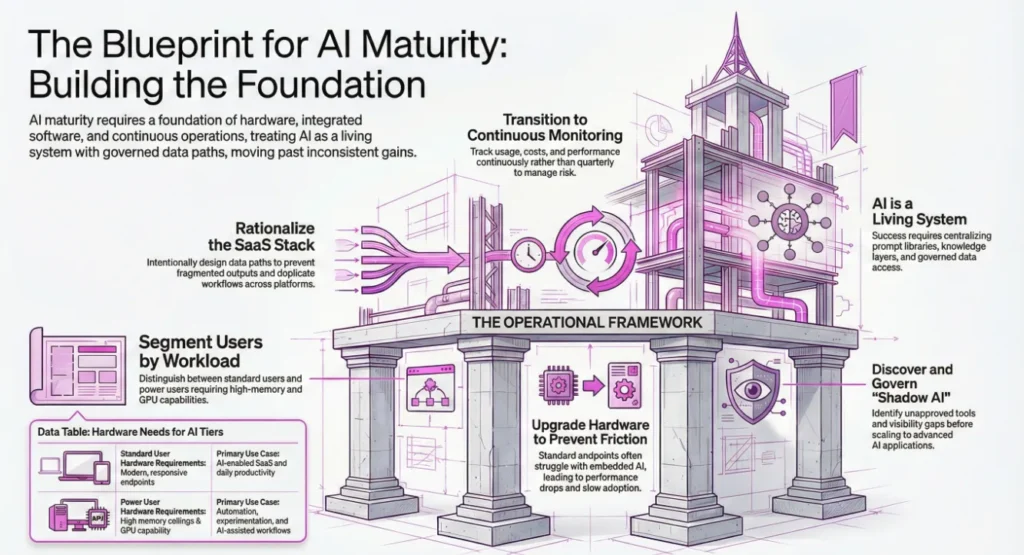
Standard endpoints struggle once AI features are embedded across daily applications. Performance drops. Friction rises. Adoption slows.

But the bigger mistake is treating all users the same.

In practice, organizations have at least two AI user classes:

Standard users

  • Need modern, responsive endpoints
  • Optimized for AI-enabled SaaS
  • Stable, secure, supportable

Power users

  • Need high memory ceilings
  • GPU capability
  • Fast local storage
  • Systems built for automation, experimentation, and AI-assisted workflows

When power users are constrained by hardware, AI becomes theoretical instead of operational.

The Next Reality: Your SaaS Stack Is Becoming Your AI Stack

Most companies haven’t fully internalized this yet.

CRM, ERP, HR, finance, support, and marketing platforms now include embedded AI and expanding data exchange paths.

Without intentional design, this creates:

  • Fragmented AI outputs
  • Duplicate prompts and workflows
  • No shared learning
  • No governance trail

AI efficiency doesn’t come from adding more tools.

It comes from making the existing stack work together — intentionally.

That requires:

  • SaaS rationalization
  • AI feature mapping
  • Integration design
  • Data path awareness

Before “Advanced AI,” the Basics Must Exist

Every successful AI program starts with uncomfortable clarity:

  • Who is using AI today?
  • Which tools — approved or not?
  • For what business outcomes?
  • With which data sources?

That leads to foundational controls:

  • Shadow AI discovery
  • AI usage visibility
  • Prompt libraries
  • Governed data access
  • Vector knowledge layers

Only after this foundation exists does the deeper AI stack make sense:

  • Data layer
  • Model selection and tuning
  • Inference platforms
  • Orchestration and agent layers
  • Workflow-embedded AI applications

Skipping these steps doesn’t accelerate AI.

It amplifies risk.

The Part Most Vendors Avoid: Ongoing AI Operations

Here’s the operational truth:

AI that isn’t monitored becomes:

  • Inconsistent
  • Expensive
  • Risky
  • Eventually ignored

AI is not a feature rollout.

It’s a living system.

It requires:

  • Usage monitoring
  • Prompt and workflow management
  • Data access control
  • Cost tracking
  • Performance measurement
  • Continuous adjustment

Not quarterly. Continuously.

A Real-World Pattern That Works

Organizations seeing real AI gains tend to follow a similar path:

They segment users by AI workload. They upgrade endpoints accordingly. They rationalize SaaS tools before adding more. They discover Shadow AI instead of pretending it doesn’t exist. They centralize prompts and knowledge sources. They govern model and data usage. They monitor AI like production infrastructure.

The result is not “AI magic.”

It’s AI that is measurable, governable, and useful.

Three Questions Worth Asking

Do your power users have hardware that enables AI — or quietly blocks it?

Can you see, in one place, which AI tools are running across your organization today?

If AI usage doubled tomorrow, would your stack scale — or spiral?

Closing Thought

The organizations getting real value from AI didn’t just buy smarter tools.

They built the right foundation. They integrated the right stack. They put operators behind it.

That’s what AI maturity actually looks like.

✅ Cybersecurity trends

✅ AI transformation

✅ IT strategy for Banking, Financial Services, and Healthcare

Leave a Comment

Your email address will not be published. Required fields are marked *

Scroll to Top

CONTEXTUAL NEXT STEP / 08 / ASSESS

Begin with a focused conversation

Turn the next
decision into a roadmap.

Share a small amount of context. We will prepare an email addressed to SoverAIgn so you can review it before sending—no false submission confirmation.

SOVERAIGN / OUTCOME NAVIGATOR

Choose your starting point

What must
move first?

Solve a real constraint now—and make that decision increase the intelligence of the whole enterprise next.

01 / OPTIMIZE

AI-Ready Software Renewals

The bridge from cost control to transformation

06 / IMPROVE

Prometheus Prompt Intelligence FREE · NEW

Better instructions. Better enterprise AI.

02 / MODERNIZE

AI Modernization

Prepare the technology foundation

03 / SECURE

AI Security

The operating system for responsible adoption

04 / DEPLOY

Atlas CXO AI Agents

Digital executive staff—not a generic chatbot

05 / ENABLE

Enterprise AI Chat Agents

Conversational intelligence for customers and employees

07 / MEASURE

AI ROI Calculator

Turn AI interest into a quantified business case

08 / ASSESS

AI Readiness + IT Spend Audit

The flagship diagnostic

SOVERAIGN FRAMEWORK / OS™

Organizational Singularity™

One intelligence.
Infinite impact.

Organizational Singularity is the point at which the enterprise behaves less like disconnected functions and more like one coordinated intelligence.

01

People

Leadership, expertise and accountability.

02

Processes

Workflows, controls and operating models.

03

Software

Applications, platforms and integrations.

04

Infrastructure

Cloud, endpoints and enterprise architecture.

05

Security

Identity, policy and resilient control.

06

Data

Context, access and governed knowledge.

07

AI

Agents, models, automation and learning.

Five barriers to enterprise AI

Models and tools are introduced without coordinated data, workflows, governance, security, ownership and adoption.

Decisions become slower and more expensive when knowledge, systems and context remain separated.

Independent pilots multiply cost while making enterprise-wide governance and reuse harder.

Critical expertise must become governed, accessible intelligence rather than remain trapped in people and files.

The destination is an operating model where every layer improves the others over time.

01 / OPTIMIZE

The bridge from cost control to transformation

AI-Ready
Software Renewals

Before you renew, determine what to keep, consolidate, replace, secure, modernize or retire—and make the next contract decision strengthen the AI-ready enterprise.

The customer problem

Renewals are being made under pressure, without a neutral view of value or future fit.

Unused licenses, overlapping products and legacy tools quietly compound technology debt. Security and AI implications are rarely considered at the procurement gate.

01

Portfolio

02

Spend

03

Roadmap

What this engagement delivers / select to expand

Build one dated view of every vendor, renewal window, owner and dependency.

Compare paid entitlement with real adoption to expose shelfware and negotiation leverage.

Find duplicate capability, fragmented contracts and candidates for consolidation.

Test each renewal against identity, data, compliance and future AI requirements.

Translate findings into a commercial position and an executable modernization sequence.

02 / MODERNIZE

Prepare the technology foundation

AI
Modernization

Remove the technical debt that prevents intelligent workflows from moving into production. Modernization connects applications, identity, cloud, endpoints, collaboration and integrations to practical AI adoption.

The customer problem

Leadership wants AI, but the existing architecture cannot support it confidently.

Legacy applications resist integration, data remains trapped across teams, identity controls vary and employees depend on manual workarounds.

01

Architecture

02

Integration

03

Adoption

What this engagement delivers / select to expand

Map the target architecture and the integration constraints blocking priority outcomes.

Establish reliable cloud, endpoint, and collaboration foundations for intelligent work.

Standardize identity so people, applications and agents receive only approved access.

Remove redundant platforms and brittle workarounds that slow every future change.

Sequence investment by business value, dependency, risk and readiness.

03 / SECURE

The operating system for responsible adoption

AI
Security

Security should enable adoption—not become a fear-based obstacle. Give executives confidence that people, data, models, and agents operate inside clear, auditable controls.

The customer problem

AI adoption is moving faster than identity, data and governance controls.

Enterprise knowledge can leak through unmanaged tools, permissions are unclear and teams cannot prove how models, prompts or agents are governed.

01

Identity

02

Knowledge

03

Control

What this engagement delivers / select to expand

Give every human, application and agent a governed identity and explicit authority.

Keep sensitive knowledge inside classified, permission-aware retrieval boundaries.

Define acceptable use, ownership, review gates and escalation before scale.

Evaluate model, prompt, vendor and autonomous-action risk as one control surface.

Create evidence through monitoring, audit trails and rehearsed incident response.

04 / DEPLOY

Digital executive staff—not a generic chatbot

Atlas
CXO AI Agents

Role-specific agents for the CEO, CIO, CISO, CFO, COO, CMO and Chief of Staff that synthesize information, prepare decisions, surface risk and preserve continuity.

The customer problem

Executive attention is fragmented across systems, meetings, reports and unfinished decisions.

Atlas creates a continuous decision-support layer while keeping judgment, authority and sensitive access firmly governed by people.

08

Executive roles

06

Core workflows

01

Governed context

What this engagement delivers / select to expand

Turn approved operating data into a concise, role-specific executive briefing.

Maintain a visible register of decisions, owners, dependencies and unresolved risk.

Compare scenarios while making evidence, assumptions and uncertainty explicit.

Prepare agendas, pre-reads, action registers and follow-through without losing context.

Watch agreed metrics and surface exceptions before they become surprises.

Recommend within defined authority while preserving human executive judgment.

Atlas / governed workflow

01

Ingest approved sources

02

Synthesize decisions and risk

03

Recommend inside authority boundariest

Atlas does not promise autonomous executive decisions, unsupervised access or replacement of executive judgment.

05 / ENABLE

Conversational intelligence for customers and employees

Enterprise AI
Chat Agents

Support high-volume, repeatable conversations where speed, consistency and access to trusted knowledge matter—from service and sales to HR and operations.

The customer problem

Enterprise knowledge exists, but people cannot reach the right answer or action fast enough.

A polished chat interface is not enough. Useful agents require grounding, permissions, escalation, analytics, integrations and continuous improvement.

01

Grounding

02

Action

03

Escalation

What this engagement delivers / select to expand

Resolve routine service needs with grounded answers and governed escalation.

Qualify demand and capture useful context without creating another disconnected inbox.

Make policy and operating knowledge searchable inside existing permission boundaries.

Handle repeatable employee requests while routing sensitive cases to people.

Guide users through products and accounts with contextual, measurable assistance.

06 / IMPROVE

Better instructions. Better enterprise AI.

Prometheus
Prompt Intelligence

Improve how teams create, evaluate, reuse and govern prompts. Prometheus is a prompt-intelligence layer—not another one-click prompt generator.

The customer problem

Prompt quality varies by person, role and tool, making AI outcomes inconsistent and difficult to govern.

Teams need shared standards that make context, constraints, evidence and output requirements explicit and reusable.

01

Quality

02

Reuse

03

Governance

What this engagement delivers / select to expand

Diagnose weak instructions and rewrite them into an execution-ready prompt.

Make role, context, evidence, constraints and required output unambiguous.

Turn high-value prompts into reusable, maintainable team assets.

Evaluate prompts against consistent quality and fabrication-risk criteria.

Create a shared operating standard for how teams instruct enterprise AI.

05 / ENABLE

Conversational intelligence for customers and employees

Enterprise AI
Chat Agents

Support high-volume, repeatable conversations where speed, consistency and access to trusted knowledge matter—from service and sales to HR and operations.

The customer problem

Enterprise knowledge exists, but people cannot reach the right answer or action fast enough.

A polished chat interface is not enough. Useful agents require grounding, permissions, escalation, analytics, integrations and continuous improvement.

01

Grounding

02

Action

03

Escalation

What this engagement delivers / select to expand

Resolve routine service needs with grounded answers and governed escalation.

Qualify demand and capture useful context without creating another disconnected inbox.

Make policy and operating knowledge searchable inside existing permission boundaries.

Handle repeatable employee requests while routing sensitive cases to people.

Guide users through products and accounts with contextual, measurable assistance.

10–100 Employees

AI-Ready SMB Technology Stack

100–1000 Employees

Enterprise AI-First Modernization Stack

Foundational control

Advanced control

  • Approved Business AI Platform
  • Gives employees a secure AI option instead of forcing them toward random consumer tools.
  • AI Email and Phishing Security
  • Protects against AI-enhanced phishing, impersonation, credential theft.
  • Endpoint Security
  • Secures the devices employees use to access AI tools, business systems, and sensitive company data.
  • AI Agent Security
  • Controls AI agents, phone agents, chat agents.
  • Logging and Monitoring
  • Provides visibility into AI use, data movement, file access, AI agent activity, and unusual behavior.
  • Incident Response for AI
  • Establishes a practical response plan for AI-related incidents before they become customer, legal, or regulatory issues.
  • AI Security Training
  • Trains employees on safe AI use, prohibited data sharing, AI phishing, prompt safety, reporting, and file handling.
Get Your Free 2-Page Overview

See exactly how Network Copilot™ fits your campus infrastructure. Perfect for briefing your team or VP of IT.

Foundation Layer

Execution Layer

Control Layer

Optimization Layer