
🧠 Strategic Intelligence Hub

Executive Intelligence for IT Leaders

Real-world insights on AI strategy, cybersecurity, cost optimization, and IT operations—from leaders who’ve been in the trenches.

Blog

Insights, tutorials, and thoughts on AI, voice technology, and the future of digital communication.

ai-50-question

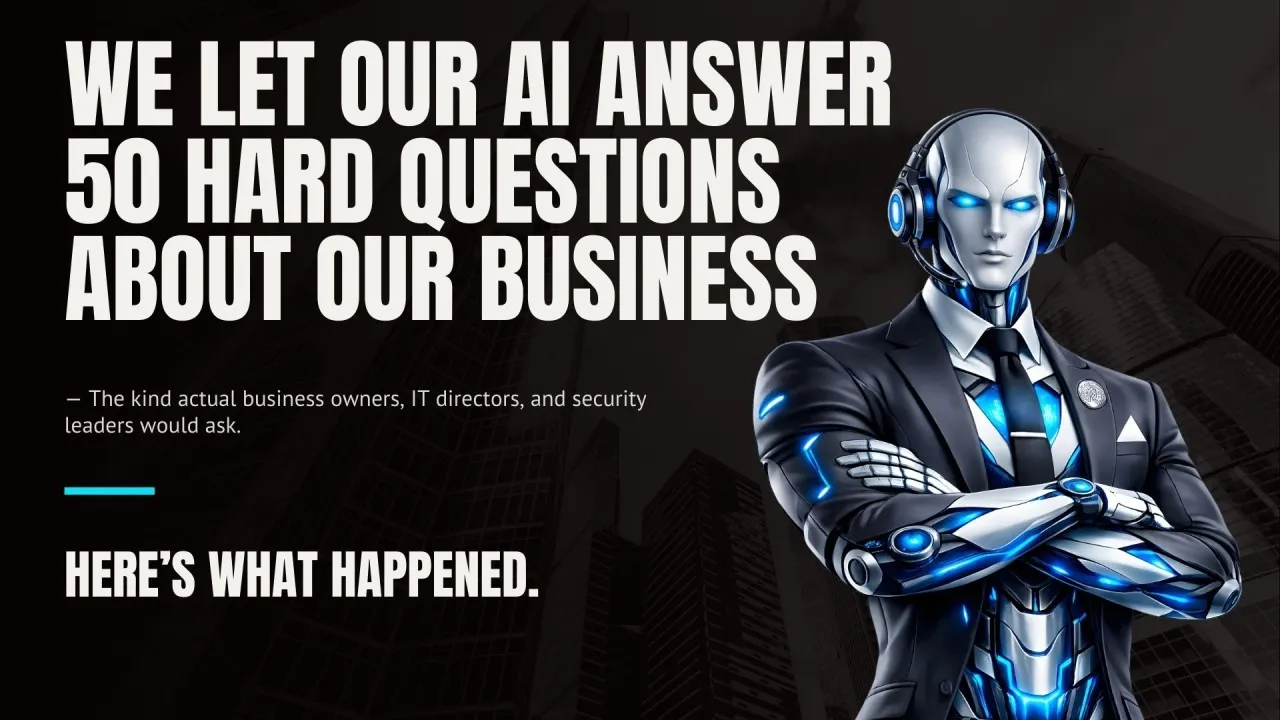
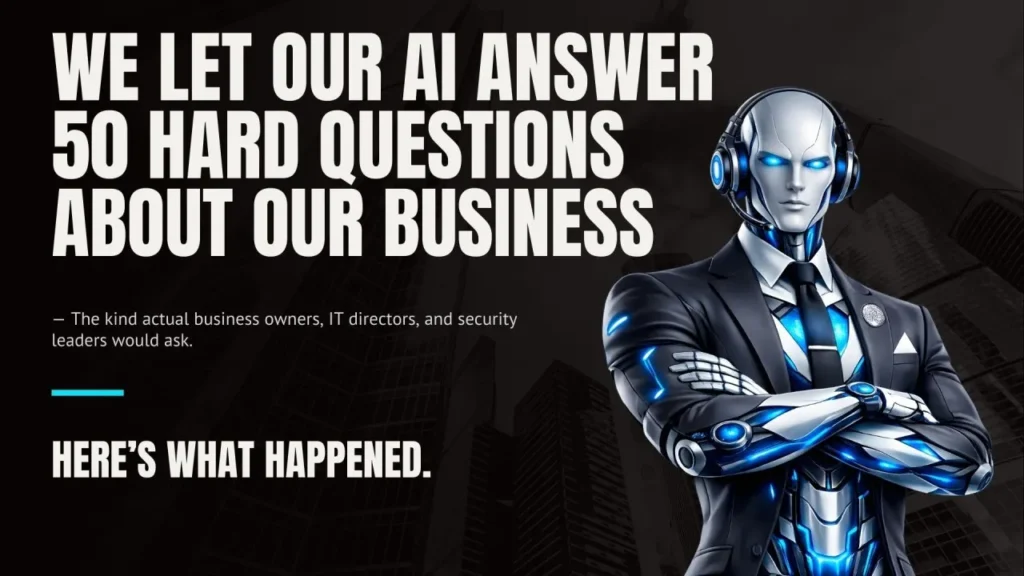
We Let Our AI Answer 50 Hard Questions About Our Business
ai-50-question

We Let Our AI Answer 50 Hard Questions About Our Business

Steven Palange

CAO CIO CSO & CISSP | Thought Leader | AI Integration & Governance Advisor to CIOs, CISOs, and CFOs Specialist in AI ROI, Risk, Compliance, and AI-Ready


Written by Steven Palange, CAO, CIO, CSO, & CISSP | Thought Leader | Helping CXOs & IT Leaders Solve Automation, AI, Cybersecurity, and Cloud with Proven, Scalable Solutions. E:steven_palange@tlic.com P: 401-214-5557

Most phone systems can route calls. Ours Can Reason.

So we tested it.

We asked our AI Phone Agent 50 real-world questions — the kind actual business owners, IT directors, and security leaders would ask.

Here’s what happened.

Special Section

Want to See All 50?
We documented every single question we used to stress-test our AI Voice Agent. All 50. From basic service questions… to cybersecurity depth… to AI governance… to real-world interruption scenarios. It’s not a brochure. It’s a live-fire evaluation framework. If you want to see the full list — and use it to test your own systems — Download the complete AI Phone Agent Stress Test (50 Questions) down below:
Try them.

Interrupt mid-sentence. Change topics. Simulate a real buyer.

If your current phone system can survive that… you’re ahead of most businesses.

Special Section:

Infographics, Video, & Audio Learning Guide that summarizes this Newsletter Article for Busy Professionals
🔊Listen to the Strategy Podcast
🎥Watch the Executive Briefing (Video)

First, The Basics

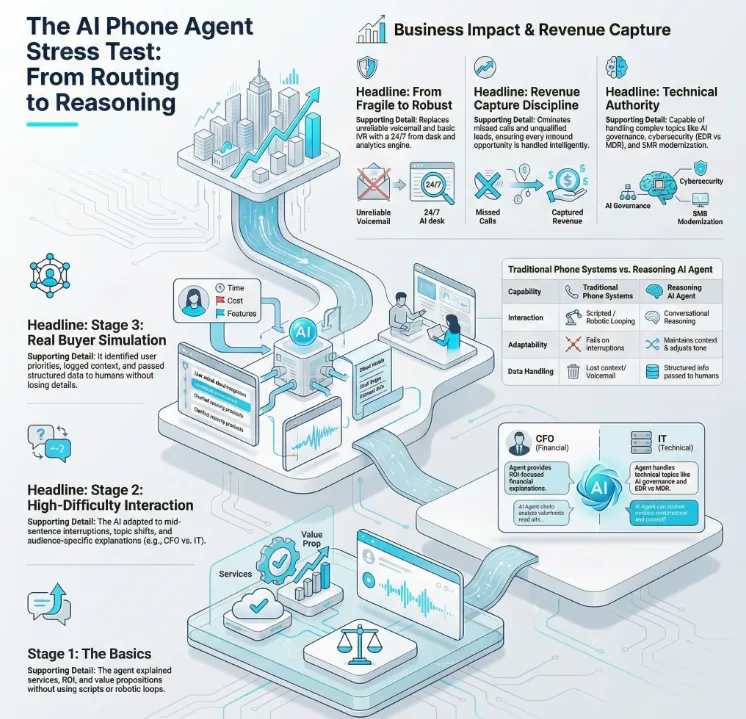
We started simple: “What services does Soveraign provide?” “How are you different from an IVR?” “What’s the ROI of replacing voicemail with AI?” The agent didn’t just route. It explained: • Services clearly • Value proposition concisely • ROI in business terms • And escalated when needed No script reading. No robotic looping.

Then We Increased the Difficulty

We interrupted it mid-sentence. Changed topics halfway through. Spoke quickly. Asked it to compare EDR vs MDR in 60 seconds. Asked it to explain Shadow AI risk to a CFO. It adapted. Maintained context. Adjusted explanations by audience. Escalated intelligently when required. That’s not a phone tree. That’s conversational reasoning.

Then, We Simulated Real Buyers

  • “I’m an IT Director with 400 users. What should I modernize first?”
  • “I’m a 75-user SMB. Where do I start with AI?”
“Transfer me to a human and tell them I’m interested in upgrading EDR.” It: • Identified priorities • Framed answers appropriately • Logged context • Passed structured information to a human No repetition. No lost details. No frustration.

Why This Matters

Every inbound call is: • A revenue opportunity • A security discussion • A sales lead • Or a support request Most SMBs still rely on: • Voicemail • Basic IVR • Or whoever happens to answer That’s fragile. An AI Voice Agent becomes: • 24/7 front desk • First-level sales qualifier • Technical explainer • Escalation router • Analytics engine All without adding payroll.

The Bigger Question

If your business received 30–100 inbound calls per week:

• How many are missed?

• How many go to voicemail?

• How many aren’t qualified properly?

• How much context is lost before a human joins?

Now multiply that by job value.

This isn’t about AI novelty. It’s about revenue capture discipline.

If you’re curious what your AI front desk could handle, we’re offering a live demo where you can ask it anything — interrupt it, test it, challenge it.

We encourage it.

Because if it can handle 50 hard questions about cybersecurity, AI governance, and SMB modernization…

It can handle your customers.

Missed Last Week’s Issue?

If you haven’t read our previous newsletter on revenue leakage and missed calls, start there.

It explains why:

Every missed call is lost revenue.

And why most businesses don’t measure it.

WE FIRED THE RECEPTIONIST

This issue builds on that foundation.

ai-calls

Your Phone System Is Bleeding Revenue

ai-calls

Your Phone System Is Bleeding Revenue

Steven Palange

CAO CIO CSO & CISSP | Thought Leader | AI Integration & Governance Advisor to CIOs, CISOs, and CFOs Specialist in AI ROI, Risk, Compliance, and AI-Ready

Every Transfer, every hang-up, every reset is silent revenue walking away.


Written by Steven Palange, CAO, CIO, CSO, & CISSP | Thought Leader | Helping CXOs & IT Leaders Solve Automation, AI, Cybersecurity, and Cloud with Proven, Scalable Solutions. E:steven_palange@tlic.com P: 401-214-5557

Special Section: Infographics, Video, & Audio Learning Guide that summarizes this Newsletter Article for Busy Professionals

🔊Listen to the Strategy Podcast
🎥Watch the Executive Briefing (Video)

They Press 1. Then 3. Then 2 Again.

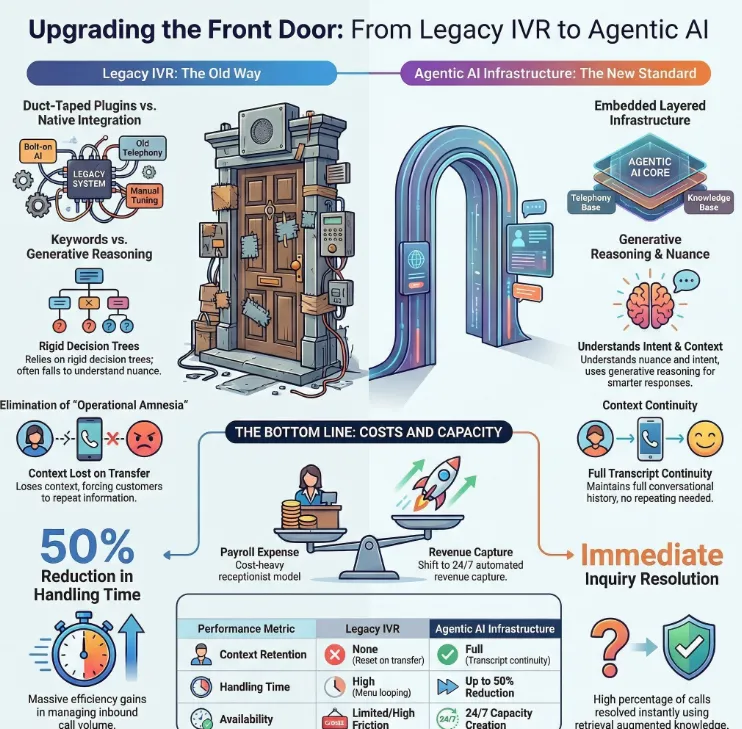
The caller already wants to hang up. Your IVR is technically “working.” But friction is bleeding credibility. Missed transfers. Looped menus. No memory. No context.

And when escalation finally happens, the human agent starts with:

“How can I help you today?”

That’s not a voice system. That’s operational amnesia.

This Was Never a Phone Problem.

Most organizations are trying to bolt intelligence onto legacy telephony.

A chatbot layered on top of an IVR. A thin API wrapper pretending to be architecture. A demo that works beautifully — until integration friction surfaces.

True AI voice isn’t a plugin.

It’s a layered infrastructure.

And the stack matters.

What Actually Sits Behind a Real AI Phone Agent

1️⃣ Native Enterprise Voice Infrastructure

Not middleware duct-taped into a PBX. AI embedded inside the business phone system itself — eliminating fragility at the integration layer.

2️⃣ Generative Reasoning Engine

Understands intent, nuance, and ambiguity. Not keywords. Not decision trees.

3️⃣ Retrieval-Augmented Knowledge

Grounded in your website, FAQs, policies, and uploaded documentation — not hallucinated responses.

4️⃣ Intelligent Routing

Routes by name, department, location, or conversational context. No keypad gymnastics.

5️⃣ Seamless AI-to-Human Handoff

Transfers with full conversational history and transcript continuity. No reset. No repetition.

6️⃣ Conversational Intelligence + Analytics

Resolution rates. Missed intent patterns. Transfer frequency. Operational blind spots you didn’t know existed.

This is not IVR.

This is agentic AI embedded inside your voice system.

The Quiet Cost Most Leaders Ignore

Receptionist = payroll expense. Missed calls = silent revenue loss.

That’s the old model.

The new model?

AI Receptionist = 24/7 revenue capture + operational intelligence engine.

Organizations deploying enterprise-grade AI reception architecture report:

• Up to 50% reduction in inbound handling time • Significant decreases in missed calls • Immediate resolution across a large percentage of inquiries

That’s not automation.

That’s capacity creation.

Before You Approve Any AI Voice Deployment

Ask this — carefully:

• Is the AI built directly into the phone infrastructure — or awkwardly layered on top? • Is it enterprise-grade and compliant? • Does it support seamless AI-to-human escalation? • Does it generate transcripts and performance analytics? • Can it scale across departments and locations without fragmentation?

If the answer is no…

It’s a demo. Not a solution.

AI Is No Longer a Support Tool

Voice is just the entry point.

When properly integrated, AI supports:

• Intelligent virtual agents • Predictive personalization • Human productivity amplification • Sentiment detection • Forecasting and performance analytics

AI is shifting from a tactical support tool to a core customer lifecycle infrastructure.

The real question isn’t:

“Should we deploy AI voice?”

It’s:

Is our infrastructure ready for it?

Experience It.

Theory is easy. Architecture is harder. Experience is undeniable.

Call our live AI Phone Agent: 📞 401 227 3451

Ask us anything about our services. Try to confuse it. See how it routes you.

Then imagine that capability deployed across your organization, because this isn’t about adding a gadget.

It’s about upgrading the front door of your business.

ai-business-system

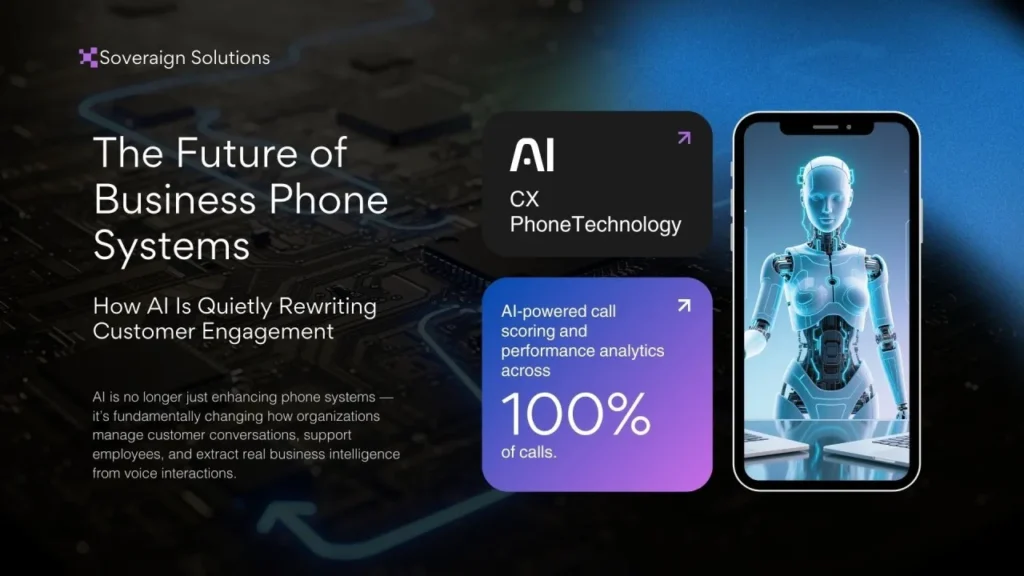
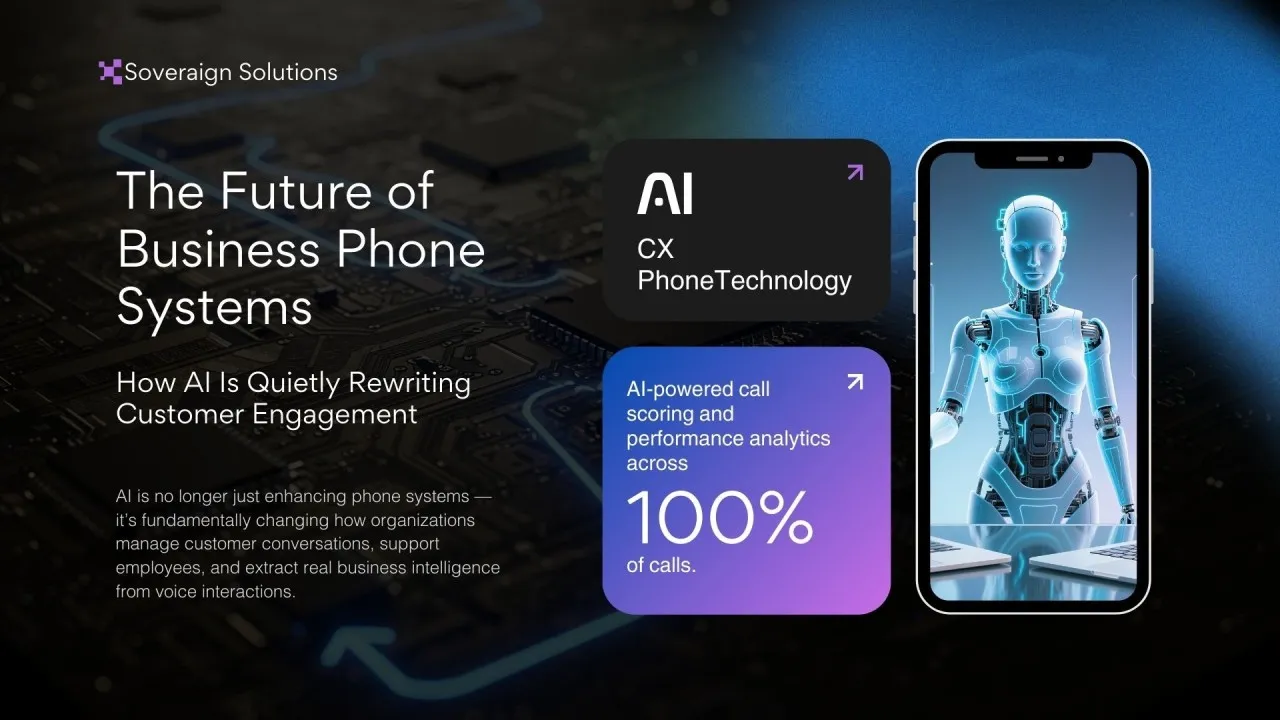
The Future of Business Phone Systems: How AI Is Quietly Rewriting Customer Engagement

ai-business-system

The Future of Business Phone Systems: How AI Is Quietly Rewriting Customer Engagement

Steven Palange

CAO CIO CSO & CISSP | Thought Leader | AI Integration & Governance Advisor to CIOs, CISOs, and CFOs Specialist in AI ROI, Risk, Compliance, and AI-Ready

Special Section: Infographics, Video, & Audio Learning Guide

🔊Listen to the Strategy Podcast

An in-depth discussion of this newsletter (Click to Listen)

🎥Watch the Executive Briefing (Video)

A 2-minute overview of this newsletter ( Click to watch )

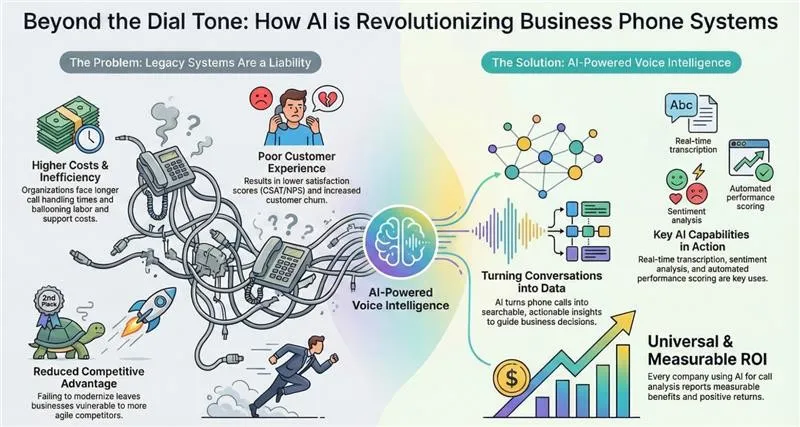
Most executives still think of AI in business phone systems as simple automation.

The data tells a very different story.

AI is no longer just enhancing phone systems — it’s fundamentally changing how organizations manage customer conversations, support employees, and extract real business intelligence from voice interactions.

Recent industry research shows that:

  • Over half of organizations have already integrated AI into phone-based customer conversations
  • Every company using AI to analyze call reports has measurable benefits

That combination — rapid adoption and universal ROI — is rare in enterprise technology.

What Leaders Are Actually Using AI Phone Systems For

The most valuable AI capabilities in modern phone systems aren’t flashy. They’re practical, operational, and measurable.

Leading organizations are using AI for:

  • Real-time call transcription and automated summaries
  • AI-powered call scoring and performance analytics across 100% of calls
  • Sentiment and intent detection during live conversations
  • Intelligent virtual agents handling routine inbound calls
  • Real-time AI assistance for employees during live customer interactions

The impact is immediate: shorter wait times, faster resolution, more consistent service — and critically, reduced employee burnout from repetitive or high-pressure calls.

The Real Breakthrough: Voice Intelligence, Not Just Telephony

The real shift isn’t replacing phone systems.

It’s turning them into intelligence platforms.

Instead of guessing:

  • Why calls escalate
  • Where training gaps exist
  • Which scripts convert
  • Why customers churn

AI-enabled phone systems provide objective, searchable, and actionable insight across every conversation.

Organizations using AI-driven voice analytics consistently report:

  • Faster issue resolution
  • Higher customer satisfaction
  • Fewer complaints
  • Better upsell and cross-sell timing
  • Stronger operational consistency

Phone calls are no longer just conversations — they’re data.

The Cost of Standing Still

The research is detailed: delaying AI adoption in phone systems has real consequences.

Leaders expect organizations that don’t modernize to face:

  • Longer call handling times
  • Higher labor and support costs
  • Lower CSAT and NPS scores
  • Increased customer churn
  • Reduced competitive advantage

At a time when customers already view long hold times as unacceptable, legacy phone systems are quickly becoming a liability.

How to Modernize Phone Systems Without Disruption

Organizations that succeed don’t rush — they execute with discipline.

The most effective approaches:

  • Tie AI phone initiatives directly to business KPIs (CSAT, AHT, resolution speed)
  • Select AI capabilities based on specific call-related pain points
  • Prepare teams early and address change management head-on
  • Measure outcomes continuously and refine fast

AI adoption works best when it’s practical, targeted, and measurable.


Bottom Line

Business phone systems are no longer just communication tools.

They are becoming core intelligence infrastructure.

The winners won’t be the companies that simply “add AI,” but those that turn every phone call into insight, efficiency, and competitive advantage.

✅ Cybersecurity trends

✅ AI transformation

✅ IT strategy for Banking, Financial Services, and Healthcare

ai-agent

Why AI CX Agents Are the Fastest Path to Revenue, Efficiency, and Modernization

ai-agent

Why AI CX Agents Are the Fastest Path to Revenue, Efficiency, and Modernization

Steven Palange

CAO CIO CSO & CISSP | Thought Leader | AI Integration & Governance Advisor to CIOs, CISOs, and CFOs Specialist in AI ROI, Risk, Compliance, and AI-Ready

📑Interactive Resources & Visual Insights

To make this strategy as practical as possible, here are resources you can explore directly:
🎧Listen to the Strategy Podcast (SoundCloud)
🎥Watch the Executive Briefing (Video)

A 2-minute overview on why AI-driven modernization is critical for Urschel and how competitors are already setting new benchmarks.

Every CEO and CFO wants three things: more revenue, lower costs, and happier customers. AI CX Chatbots and VoiceBots trained on your proprietary data — CRM notes, policies, SOPs, product documentation, and more — deliver all three.

But here’s the catch: the AI is only as good as the team deploying, integrating, and maintaining it. That’s where Soveraign Solutions comes in. We are more than a vendor; we are your full IT, Security, and AI Integration team, replacing 3–5 internal roles for a fraction of the cost — starting at just 20 hours/month for $400.

Instant ROI from Day One

An AI CX Agent is more than a digital assistant — it’s a 24/7 sales and support powerhouse:

  • 24/7 availability: No abandoned sessions, no frustrated prospects, no missed opportunities
  • Higher conversions: 20–40% more new customers
  • Support cost reduction: 30–50% savings
  • Staff replacement: Replaces multiple full-time roles

Your homepage becomes a round-the-clock sales rep, answering questions, booking qualified meetings, and updating Salesforce or HubSpot automatically. Meanwhile, your team focuses on high-value, revenue-driving tasks, while the AI handles repetitive tickets, FAQs, and scheduling.

Accuracy That Builds Confidence

Unlike generic AI or chatbot vendors, our AI CX Agents are trained on your proprietary data, ensuring:

  • Accurate answers: Policies, products, pricing, SOPs, CRM notes
  • Compliance: Reduces errors and prevents regulatory issues
  • Consistency: Every interaction reinforces trust with customers

Real-Time Intelligence & Insights

Every interaction with your AI CX Agent generates actionable insights:

  • Customer intent: What products or services they are most interested in
  • Friction points: Where website content or processes confuse prospects
  • Missed opportunities: Identify leads or upsells slipping through the cracks

These insights inform smarter decisions in marketing, sales, and product strategy, without adding extra human effort.

Scalable, Reliable, and Always On

Our AI CX Agents are designed for enterprise-grade performance, even for SMBs:

  • 24/7 availability: No PTO, no sick days, no downtime
  • Scalable: Handles hundreds or thousands of conversations
  • Multichannel: Web, voice, SMS, CRM-integrated workflows
  • No burnout: Eliminates missed calls, chats, emails, and weekend staffing

Why Partner With Us

Unlike standalone chatbot vendors or generic AI providers, we don’t just install software and walk away. We become your IT, Security, and AI Integration team, handling every layer of deployment and ongoing operations.

Here’s what we manage for you:

Infrastructure & Security

  • Protect servers, endpoints, and networks
  • Ensure compliance and audit readiness
  • Maintain uptime and reliability

AI Training & Accuracy

  • Ingest proprietary data: CRM notes, policies, SOPs, product docs
  • Tailor responses to your business context
  • Reduce errors, improve compliance, and boost trust

Workflow & Integration

  • Automate multi-channel workflows: web, voice, SMS, CRM
  • Connect AI to Salesforce, HubSpot, or internal systems
  • Optimize scheduling, lead qualification, and ticketing

Continuous Optimization

  • Monitor AI performance and improve response accuracy
  • Quarterly enhancements to IT efficiency, security posture, and CX outcomes
  • Ensure measurable ROI — more conversions, lower costs, higher satisfaction

Bottom line: Your AI CX Agent becomes a strategic revenue and efficiency engine, not just another tool. We handle the heavy lifting so your team can focus on high-value, revenue-driving tasks.

Why CEOs & CFOs Approve

Implementing an AI CX Agent with Soveraign Solutions delivers the outcomes executives care about most:

  • More Revenue: instant engagement, higher conversions, and upsells
  • Lower Operating Costs: reduced support headcount and operational efficiency
  • Better Customer Experience: accurate, fast, 24/7 responses
  • Zero Additional Headcount: scale without hiring

This is why AI CX Agents are often the first automation SMBs implement when modernizing operations and customer experience.

Next Steps

See exactly how this works for your business with a 15-minute consultation. We’ll show you:

  • How AI can cut support costs 30–50%
  • How it can capture more leads and increase conversions 20–40%
  • How our MSP/MSSP/AI Integration team handles everything securely, reliably, and efficiently

No extra headcount. No risk. All ROI.

✅ Cybersecurity trends

✅ AI transformation

✅ IT strategy for Banking, Financial Services, and Healthcare

AI Takes a Village — and a Tech Stack (and Someone to Run It)

AI Takes a Village — and a Tech Stack (and Someone to Run It)

Steven Palange

CAO CIO CSO & CISSP | Thought Leader | AI Integration & Governance Advisor to CIOs, CISOs, and CFOs Specialist in AI ROI, Risk, Compliance, and AI-Ready


Written by Steven Palange, CAO, CIO, CSO, & CISSP | Thought Leader | Helping CXOs & IT Leaders Solve Automation, AI, Cybersecurity, and Cloud with Proven, Scalable Solutions. E:steven_palange@tlic.com P: 401-214-5557

Special Section: Infographics, Video, & Audio Learning Guide that summarizes this Newsletter Article for Busy Professionals

🔊Listen to the Strategy Podcast
🎥Watch the Executive Briefing (Video)

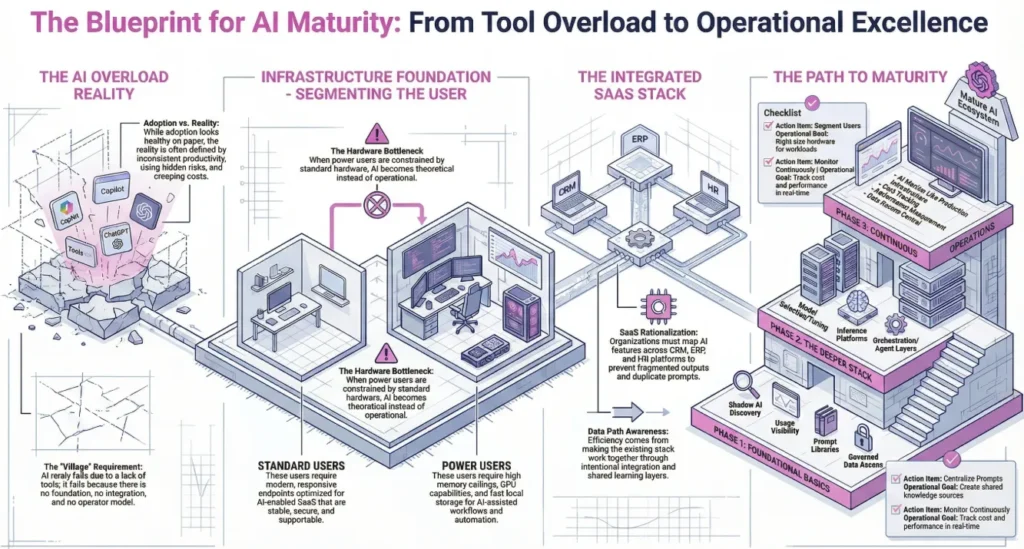
Most organizations are not behind on AI anymore.

They’re overloaded.

Copilot is deployed. ChatGPT is approved. SaaS platforms quietly added AI features. Power users are experimenting beyond policy.

On paper, adoption looks healthy.

In reality, the pattern looks different:

  • Productivity gains are inconsistent
  • Risk is rising quietly
  • Costs are creeping upward
  • Accountability is unclear

And leadership keeps asking the same question:

“What AI are we actually running — and who owns it?”

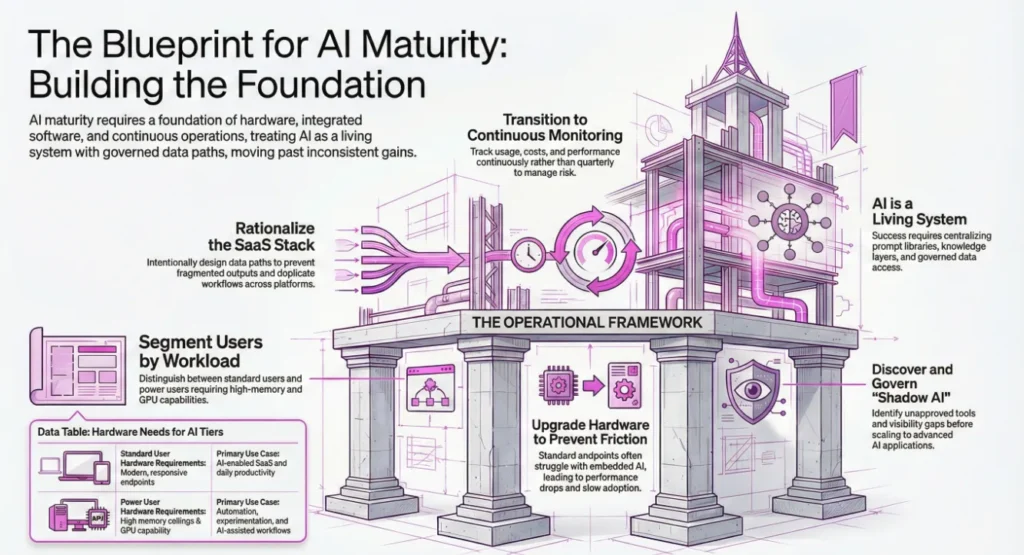
AI rarely fails because of missing tools. It fails because there is no foundation, no integration, and no operator model.

AI takes a village — and a stack — and people who can run both.

The Layer Most Companies Underestimate: Hardware

AI exposes weak infrastructure immediately.

Standard endpoints struggle once AI features are embedded across daily applications. Performance drops. Friction rises. Adoption slows.

But the bigger mistake is treating all users the same.

In practice, organizations have at least two AI user classes:

Standard users

  • Need modern, responsive endpoints
  • Optimized for AI-enabled SaaS
  • Stable, secure, supportable

Power users

  • Need high memory ceilings
  • GPU capability
  • Fast local storage
  • Systems built for automation, experimentation, and AI-assisted workflows

When power users are constrained by hardware, AI becomes theoretical instead of operational.

The Next Reality: Your SaaS Stack Is Becoming Your AI Stack

Most companies haven’t fully internalized this yet.

CRM, ERP, HR, finance, support, and marketing platforms now include embedded AI and expanding data exchange paths.

Without intentional design, this creates:

  • Fragmented AI outputs
  • Duplicate prompts and workflows
  • No shared learning
  • No governance trail

AI efficiency doesn’t come from adding more tools.

It comes from making the existing stack work together — intentionally.

That requires:

  • SaaS rationalization
  • AI feature mapping
  • Integration design
  • Data path awareness

Before “Advanced AI,” the Basics Must Exist

Every successful AI program starts with uncomfortable clarity:

  • Who is using AI today?
  • Which tools — approved or not?
  • For what business outcomes?
  • With which data sources?

That leads to foundational controls:

  • Shadow AI discovery
  • AI usage visibility
  • Prompt libraries
  • Governed data access
  • Vector knowledge layers

Only after this foundation exists does the deeper AI stack make sense:

  • Data layer
  • Model selection and tuning
  • Inference platforms
  • Orchestration and agent layers
  • Workflow-embedded AI applications

Skipping these steps doesn’t accelerate AI.

It amplifies risk.

The Part Most Vendors Avoid: Ongoing AI Operations

Here’s the operational truth:

AI that isn’t monitored becomes:

  • Inconsistent
  • Expensive
  • Risky
  • Eventually ignored

AI is not a feature rollout.

It’s a living system.

It requires:

  • Usage monitoring
  • Prompt and workflow management
  • Data access control
  • Cost tracking
  • Performance measurement
  • Continuous adjustment

Not quarterly. Continuously.

A Real-World Pattern That Works

Organizations seeing real AI gains tend to follow a similar path:

They segment users by AI workload. They upgrade endpoints accordingly. They rationalize SaaS tools before adding more. They discover Shadow AI instead of pretending it doesn’t exist. They centralize prompts and knowledge sources. They govern model and data usage. They monitor AI like production infrastructure.

The result is not “AI magic.”

It’s AI that is measurable, governable, and useful.

Three Questions Worth Asking

Do your power users have hardware that enables AI — or quietly blocks it?

Can you see, in one place, which AI tools are running across your organization today?

If AI usage doubled tomorrow, would your stack scale — or spiral?

Closing Thought

The organizations getting real value from AI didn’t just buy smarter tools.

They built the right foundation. They integrated the right stack. They put operators behind it.

That’s what AI maturity actually looks like.

✅ Cybersecurity trends

✅ AI transformation

✅ IT strategy for Banking, Financial Services, and Healthcare

Scroll to Top